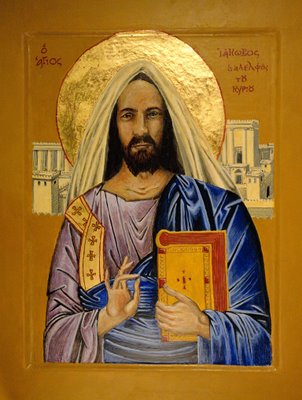
The name "James" is the English equivalent of the Greek Iakobus, thus is a variation of "Jacob."
The original "Jacob" of the Old Testament was the grandson of Abraham (Gen 25:19—36:43)
Jacob's twelve sons (Gen 29:31—30:24; 35:16-18) became the patriarchs of the "Twelve Tribes of Israel."
Thus, you can imagine how popular this name was among Jews of every generation.
There are several men named "Jacob/James" in the New Testament:
James, the son of Zebedee, the brother of John - one of the first four disciples of Jesus (Mark 1:19-20; Matt 4:21-22); one of the twelve "apostles" (Mark 3:17; Matt 10:2); actually one of the three or four closest to Jesus throughout his public ministry (Mark 5:37; 9:2; 13:3; 14:33; pars.); killed by King Herod Agrippa I around 40 CE (Acts 12:2).
James, the son of Alphaeus - another one of the twelve apostles (Mark 3:18 & par.), but little is known about him.
James, the father of Judas - the father of yet another of the twelve apostles (acc. to Luke 6:16 & Acts 1:13).
James, the "brother" of the Lord - listed first among the four "brothers" of Jesus mentioned in the Synoptic Gospels (Mark 6:3; Matt 13:55; cf. Mark 3:31-34; Matt 12:46-50); he later becomes the leader of the early Christian community in Jerusalem (Acts 12:17; 15:13; 21:18; 1Cor 15:7; Gal 1:19; 2:9); Paul calls him an "apostle" (Gal 1:19), although there are some tensions between Paul and some "people from James" who insist that non-Jewish Christians must be circumcised (Gal 2:12). According to Josephus (Ant. 20.9.1), James was stoned to death in the early 60's at the time of the high priest Ananus II.
The author of the epistle simply identifies himself as "James, a servant/slave of God and of the Lord Jesus Christ" (1:1).
Christian tradition and biblical scholars generally agree that the author is the fourth James listed above.
Some scholars, however, suggest the letter is pseudepigraphic (written by someone else, after the death of James).
Authenticity and Date?
This issue is disputed among scholars and difficult to determine. Some scholars maintain that it was actually written by James the Just, the brother of the Lord. Others argue that is is pseudepigraphic, written sometime later in the first century by a Jewish-Christian who wanted to honor and continute the legacy James, the leader of the early Jewish-Christian church in Jerusalem.
[a list of reasons, pro & con, may be added some day]
The Centrality of Faith and Its Inseparable Connection with Good Works:
James stresses the importance of living faith, endurance in trials, and faith-filled undoubting prayer to God:
James 1:2-7 – “My brothers and sisters, whenever you face trials of any kind, consider it nothing but joy, 3 because you know that the testing of your faith produces endurance; 4 and let endurance have its full effect, so that you may be mature and complete, lacking in nothing. 5 If any of you is lacking in wisdom, ask God, who gives to all generously and ungrudgingly, and it will be given you. 6 But ask in faith, never doubting, for the one who doubts is like a wave of the sea, driven and tossed by the wind; 7 for the doubter, being double-minded and unstable in every way, must not expect to receive anything from the Lord.”
James 2:1 – “My brothers and sisters, do you with your acts of favoritism really believe inour glorious Lord Jesus Christ?” (NRSV)
(or RSV: “My brethren, show no partiality as you holdthe faith of our Lord Jesus Christ, the Lord of glory.”)
James 5:14-16 – “Are any among you sick? They should call for the eldersof the church and have them pray over them, anointing them with oil in the name of the Lord. 15 The prayer of faith will save the sick, and the Lord will raise them up; and anyone who has committed sins will be forgiven. 16 Therefore confess your sins to one another, and pray for one another, so that you may be healed. The prayer of the righteous is powerful and effective.”
James stresses the necessity of putting one's faith into action, esp. through care of the poor and needy:
James 1:22-27 – “But be doers of the word, and not merely hearers who deceive themselves. 23 For if any are hearers of the word and not doers, they are like those who look at themselves in a mirror; 24 for they look at themselves and, on going away, immediately forget what they were like. 25 But those who look into the perfect law, the law of liberty, and persevere, being not hearers who forget but doers who act--they will be blessed in their doing. 26 If any think they are religious, and do not bridle their tongues but deceive their hearts, their religion is worthless. 27 Religion that is pure and undefiled before God, the Father, is this:to care for orphans and widows in their distress, and to keep oneself unstained by the world.”
James 2:5-6a, 8 – “Listen, my beloved brothers and sisters. Has not God chosen the poor in the world to be rich in faith and to be heirs of the kingdom that he has promised to those who love him? / But you have dishonored the poor... / You do well if you really fulfill the royal law according to the scripture, 'You shall love your neighbor as yourself.' ” (citing Lev 19:18; cf. Matt 5:34; 19:19; 22:39)
James 2:14-26 – “What good is it, my brothers and sisters, if you say you have faith but do not have works? Can faith save you? 15 If a brother or sister is naked and lacks daily food, 16 and one of you says to them, 'Go in peace; keep warm and eat your fill,' and yet you do not supply their bodily needs, what is the good of that? 17 So faith by itself, if it has no works, is dead.18 But someone will say, "You have faith and I have works." Show me your faith apart from your works, and I by my works will show you my faith. 19 You believe that God is one; you do well. Even the demons believe--and shudder. 20 Do you want to be shown, you senseless person, that faith apart from works is barren? 21 Was not our ancestor Abraham justified by works when he offered his son Isaac on the altar? 22 You see that faith was active along with his works, and faith was brought to completion by the works. 23 Thus the scripture was fulfilled that says, "Abraham believed God, and it was reckoned to him as righteousness," and he was called the friend of God. 24 You see that a person is justified by works and not by faith alone. 25 Likewise, was not Rahab the prostitute also justified by works when she welcomed the messengers and sent them out by another road? 26 For just as the body without the spirit is dead, so faith without works is also dead.”
Ethical Teachings of James and Jesus / Parallels in James and Matthew:
There are many similarities between passages of James and teachings of Jesus as recorded in Matthew's Gospel, especially in the Sermon on the Mount (Matt 5—7).
These are not exact parallels in wording, however, nor are they in the same order; so they do not imply direct literary dependence of one text on the other.
JAMES
Teaching
cf. Matthew
1:2
Be joyful in the midst of various trials
5:11-12
1:4
Be perfect, complete, and lack nothing
5:48
1:5
Ask from God, who gives generously
7:7
1:6
Ask in faith; do not doubt
21:21
1:19-20
Be slow to anger; anger does not lead to righteousness
5:22
1:22
Be doers of the word, not just hearers
7:24
2:5
God has chosen the poor as heirs of the kingdom
5:3
2:8
Love your neighbor as yourself (cf. Lev. 19:18)
22:39
2:10
Whoever fails to keep one law becomes guilty of it all
5:19
2:13
Judgment will be merciless for those who are not merciful
5:7
3:1
Not many of you should become teachers
23:8
3:2-10
Bridle the tongue
12:36-37
3:12
Can a fig tree bear olives, or a vine figs?
7:16
3:18
Righteousness is sown in peace for those who make peace
5:9
4:4
Friendship with the world is enmity toward God
6:24
4:10
Humble yourself before the Lord, and he will lift you up
5:5
5:2-3
Your wealth has rotted... your gold and silver are rusted...
6:19-20
5:7-8
Be patient until the coming of the Lord
24:13
5:9a
Do not complain against others, so you may not be judged
7:1
5:9b
The judge is standing at the door
24:33
5:10
Take the patience of the prophets as an example of suffering
5:12
5:12
Do not swear by heaven or earth... let your 'yes' be 'yes', your 'no' be 'no'
5:34-37
Dangers of Riches:
James 1:9-11 – “Let the believer who is lowly boast in being raised up, 10 and the rich in being brought low, because the rich will disappear like a flower in the field. 11 For the sun rises with its scorching heat and withers the field; its flower falls, and its beauty perishes. It is the same way with the rich; in the midst of a busy life, they will wither away.”
James 2:1-4 – “My brothers and sisters, do you with your acts of favoritism really believe in our glorious Lord Jesus Christ? 2 For if a person with gold rings and in fine clothes comes into your assembly, and if a poor person in dirty clothes also comes in, 3 and if you take notice of the one wearing the fine clothes and say, "Have a seat here, please," while to the one who is poor you say, "Stand there," or, "Sit at my feet," 4 have you not made distinctions among yourselves, and become judges with evil thoughts?”
James 2:5-7 – “Listen, my beloved brothers and sisters. Has not God chosen the poor in the world to be rich in faith and to be heirs of the kingdom that he has promised to those who love him? 6 But you have dishonored the poor. Is it not the rich who oppress you? Is it not they who drag you into court? 7 Is it not they who blaspheme the excellent name that was invoked over you?”
James 5:1-6 – “Come now, you rich people, weep and wail for the miseries that are coming to you. 2 Your riches have rotted, and your clothes are moth-eaten. 3 Your gold and silver have rusted, and their rust will be evidence against you, and it will eat your flesh like fire. You have laid up treasure for the last days. 4 Listen! The wages of the laborers who mowed your fields, which you kept back by fraud, cry out, and the cries of the harvesters have reached the ears of the Lord of hosts. 5 You have lived on the earth in luxury and in pleasure; you have fattened your hearts in a day of slaughter. 6 You have condemned and murdered the righteous one, who does not resist you.”
Dangers of the Tongue:
James 1:19b-20 – “...let everyone be quick to listen, slow to speak, slow to anger. for your anger does not produce God's righteousness.”
James 1:26 – “If any think they are religious, and do not bridle their tongues but deceive their hearts, their religion is worthless.”
James 2:6-7 – “...Is it not the rich who oppress you? Is it not they who drag you into court? / Is it not they who blaspheme the excellent name that was invoked over you?”
James 2:12 – “So speak and so act as those who are to be judged by the law of liberty.”
James 3:1-10 – “Not many of you should become teachers, my brothers and sisters, for you know that we who teach will be judged with greater strictness. 2 For all of us make many mistakes. Anyone who makes no mistakes in speaking is perfect, able to keep the whole body in check with a bridle. 3 If we put bits into the mouths of horses to make them obey us, we guide their whole bodies. 4 Or look at ships: though they are so large that it takes strong winds to drive them, yet they are guided by a very small rudder wherever the will of the pilot directs. 5 So also the tongue is a small member, yet it boasts of great exploits. How great a forest is set ablaze by a small fire! 6 And the tongue is a fire. The tongue is placed among our members as a world of iniquity; it stains the whole body, sets on fire the cycle of nature, and is itself set on fire by hell. 7 For every species of beast and bird, of reptile and sea creature, can be tamed and has been tamed by the human species, 8 but no one can tame the tongue-- a restless evil, full of deadly poison. 9 With it we bless the Lord and Father, and with it we curse those who are made in the likeness of God. 10 From the same mouth come blessing and cursing. My brothers and sisters, this ought not to be so.”
James 3:14 – “But if you have bitter envy and selfish ambition in your hearts, do not be boastful and false to the truth.”
James 4:1-3 – “Those conflicts and disputes among you, where do they come from? Do they not come from your cravings that are at war within you? / You want something and do not have it; so you commit murder. And you covet something and cannot obtain it; so you engage in disputes and conflicts. You do not have, because you do not ask. / You ask and do not receive, because you ask wrongly, in order to spend what you get on your pleasures.”
James 4:11-16 – “Do not speak evil against one another, brothers and sisters. Whoever speaks evil against another or judges another, speaks evil against the law and judges the law; but if you judge the law, you are not a doer of the law but a judge... 13 Come now, you who say, "Today or tomorrow we will go to such and such a town and spend a year there, doing business and making money." 14 Yet you do not even know what tomorrow will bring. What is your life? For you are a mist that appears for a little while and then vanishes. 15 Instead you ought to say, "If the Lord wishes, we will live and do this or that." 16 As it is, you boast in your arrogance; all such boasting is evil.”
James 5:9a – “Beloved, do not grumble against one another, so that you may not be judged.”
James 5:12 – “Above all, my beloved, do not swear, either by heaven or by earth or by any other oath, but let your "Yes" be yes and your "No" be no, so that you may not fall under condemnation.”
Forgiveness of Sins and Anointing of the Sick:
James 1:13-15 – “No one, when tempted, should say, 'I am being tempted by God'; for God cannot be tempted by evil and he himself tempts no one. 14 But one is tempted by one's own desire, being lured and enticed by it; 15 then, when that desire has conceived, it gives birth to sin, and that sin, when it is fully grown, gives birth to death.”"
James 2:8-10 – “You do well if you really fulfill the royal law according to the scripture, 'You shall love your neighbor as yourself.' 9 But if you show partiality, you commit sin and are convicted by the law as transgressors. 10 For whoever keeps the whole law but fails in one point has become accountable for all of it...”
James 4:1-17 – “Those conflicts and disputes among you, where do they come from? Do they not come from your cravings that are at war within you? / ... 7 Submit yourselves therefore to God. Resist the devil, and he will flee from you. 8 Draw near to God, and he will draw near to you. Cleanse your hands, you sinners, and purify your hearts, you double-minded. / ... 16 As it is, you boast in your arrogance; all such boasting is evil. 17 Anyone, then, who knows the right thing to do and fails to do it, commits sin.”
James 5:13-20 – “Are any among you suffering? They should pray. Are any cheerful? They should sing songs of praise. 14 Are any among you sick? They should call for the elders of the church and have them pray over them, anointing them with oil in the name of the Lord. 15 The prayer of faith will save the sick, and the Lord will raise them up; and anyone who has committed sins will be forgiven. 16 Therefore confess your sins to one another, and pray for one another, so that you may be healed. The prayer of the righteous is powerful and effective. 17 Elijah was a human being like us, and he prayed fervently that it might not rain, and for three years and six months it did not rain on the earth. 18 Then he prayed again, and the heaven gave rain and the earth yielded its harvest. 19 My brothers and sisters, if anyone among you wanders from the truth and is brought back by another, 20 you should know that whoever brings back a sinner from wandering will save the sinner's soul from death and will cover a multitude of sins.”
Several points should be noted in this last passage:
The close connection between the healing of illness, the forgiveness of sins, and the prayer of faith.
The role of the elders ("presbyters") in praying over the sick and anointing them with oil (cf. Mark 6:13).
The role of the entire community in praying for one another and in confessing their sins to one another.
Why do many people think there is a contradiction between the teachings of James and Paul on faith and works? Why is this really just a difference in emphasis, but not really a contradiction? How are the differences to be understood properly?
What does James say about the power of the tongue, the role of speech in our lives, and the importance of avoiding slander?
What does James say about riches and wealth? What does he say about rich people? What does he say directly to rich people?
What is the relationship between sickness and sin, according to James 5:13-20?
How are the sacraments of penance/reconciliation and anointing of the sick as practiced in the Churches today similar to or different from the early Christian practices reflected in James 5:13-18?
